

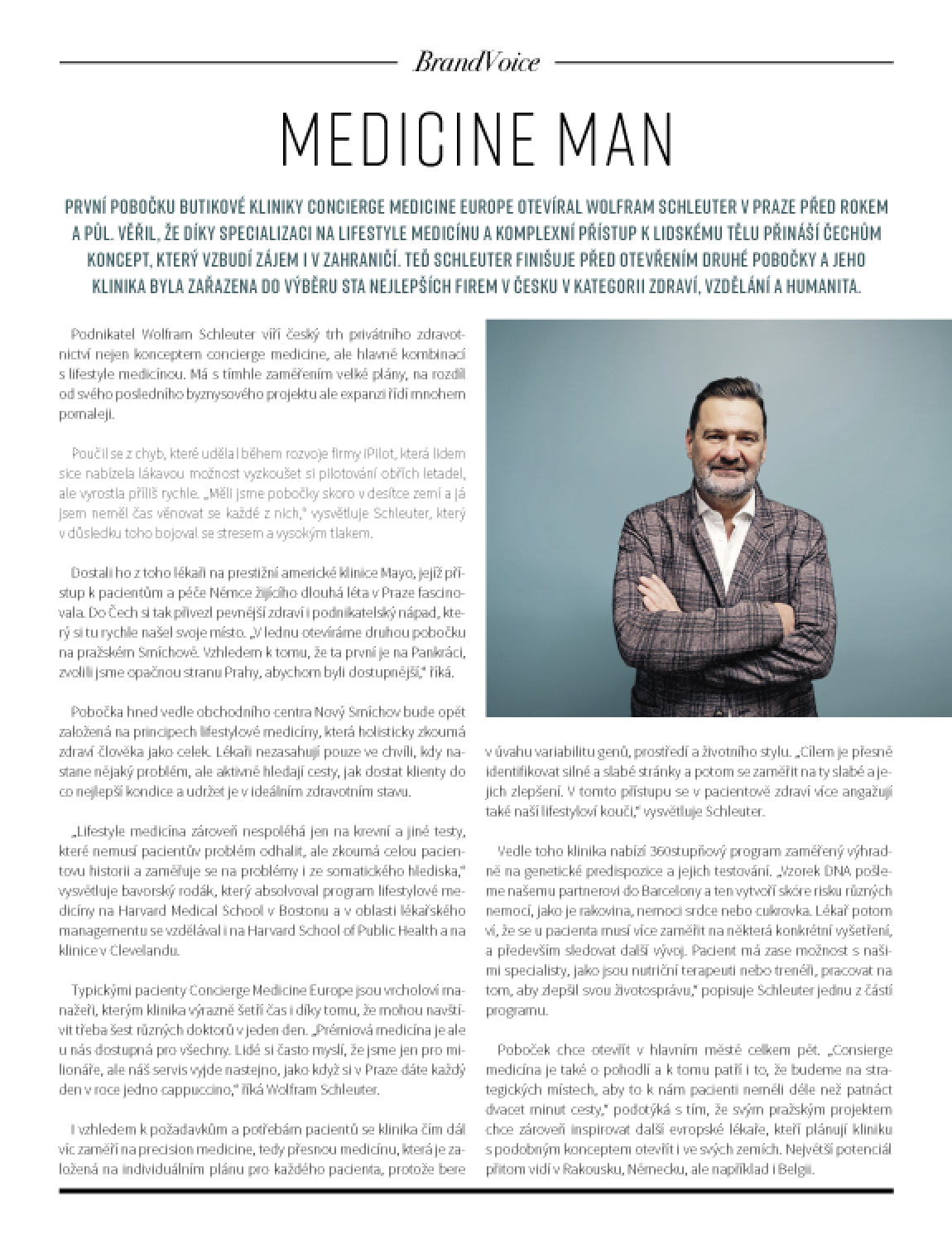
Wolfram Schleuter opened the first branch of the boutique clinic Concierge Medicine Europe in Prague a year and a half ago. He believed that thanks to his specialization in lifestyle medicine and a comprehensive approach to the human body, he was bringing the Czechs a concept that would also arouse interest abroad. Now Schleuter is finishing up before opening the second branch, and his clinic was included in the selection of the best companies in the Czech Republic in the Health, Education and Humanity category.
Entrepreneur Wolfram Schleuter is stirring up the Czech private healthcare market not only with the concept of concierge medicine, but mainly with a combination with lifestyle medicine. He has big plans for this focus, but unlike his last business project, he is managing the expansion much more slowly.
He learned from the mistakes he made during the development of iPilot, which offered people the tempting opportunity to try piloting giant aircraft, but grew too quickly. “We had branches in almost a dozen countries and I didn’t have time to devote myself to each of them,” explains Schleuter, who as a result struggled with stress and high pressure.
He was saved by doctors at the prestigious American Mayo Clinic, whose approach to patients and care fascinated the German who had lived in Prague for many years. He brought back to the Czech Republic both better health and a business idea that quickly found its place here. “In January, we are opening a second branch in Smíchov, Prague. Given that the first one is in Pankrác, we chose the opposite side of Prague to be more accessible,” he says.
The branch right next to the Nový Smíchov shopping center will again be based on the principles of lifestyle medicine, which holistically examines a person’s health as a whole. Doctors do not intervene only when a problem occurs, but also look for ways to get them in the best possible shape and maintain them in optimal health.
“Lifestyle medicine does not rely solely on blood and other tests that may not reveal the patient’s problem, but examines the entire history of the area and focuses on problems from a somatic perspective,” explains the Bavarian native, who graduated from the lifestyle medicine program at Harvard Medical School in Boston and also studied medical management at the Harvard School of Public Health and the Cleveland Clinic.
Typical Concierge Medicine Europe clients are top managers, for whom the clinic saves a lot of time, thanks to the fact that they can visit six different doctors in one day. “But premium medicine is available to everyone. People often think that we are only for millionaires, but our service is the same as having a cappuccino every day of the year in Prague,” says Wolfram Schleuter.
Also, given the conditions and needs of patients, the clinic is increasingly focusing on precision medicine, i.e. precise medicine that is based on an individual plan for each patient, because it takes into account the variability of genes, environment and lifestyle. “The goal is to precisely identify strengths and weaknesses and then focus on the weak points and their patients. Our lifestyle coaches are also more involved in this approach to health,” explains Schleuter.
In addition, the clinic offers a 360-degree program focused exclusively on genetic predispositions and their testing. “We send the DNA sample to our partner in Barcelona and they create a risk score for various diseases, such as cancer, heart disease or diabetes. The doctor then knows that he needs to focus more on some specific examinations for the patient, and above all, monitor further development. The patient, in turn, has the opportunity to work with our specialists, such as the program’s nutritional therapists or trainers, to improve their lifestyle from one,” explains Schleuter.
The clinic wants to open a total of five branches in the capital. “Consierge medicine is also convenient for doctors, and that includes being in strategic locations so that patients don’t have to travel more than fifteen to twenty minutes to reach us,” he notes, adding that he also wants to inspire other Europeans with his Prague project who are planning to open a clinic with a similar concept in their countries. He sees the greatest potential in Austria, Germany, but also Belgium, for example.